
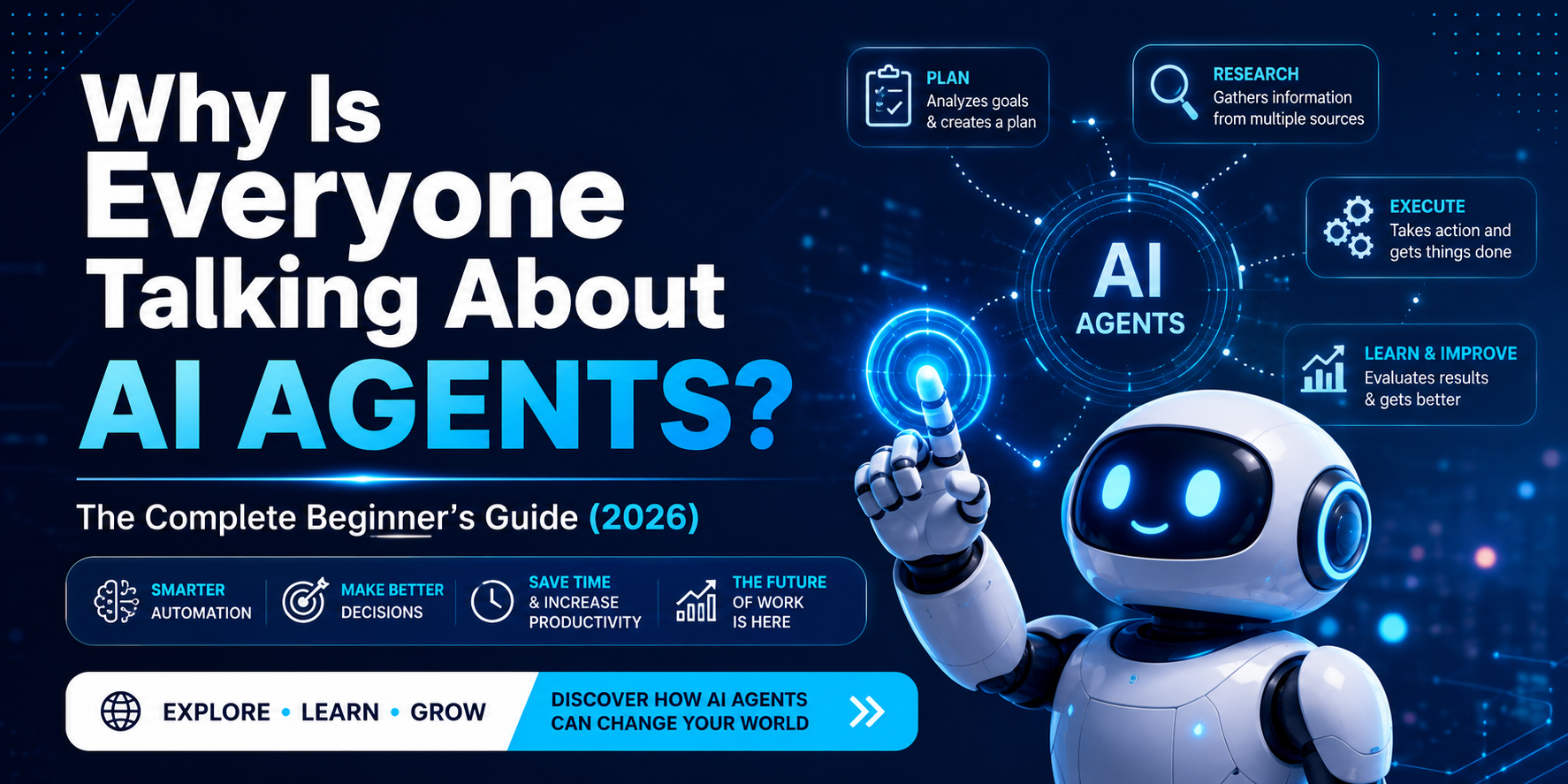
Artificial Intelligence (AI) has evolved rapidly over the last few years, but one term is suddenly appearing everywhere—AI Agents. Whether you’re reading tech news, browsing social media, or watching YouTube, chances are you’ve come across headlines claiming that AI agents are the future of work, business, and everyday life.
But what exactly are AI agents? Why are companies investing billions of dollars in them? And should you care?
In this comprehensive guide, we’ll explain everything in simple language—without the confusing technical jargon.
What Is an AI Agent?
An AI agent is an intelligent software program that can understand a goal, make decisions, perform multiple tasks, and adapt based on results with little or no human intervention.
Unlike a traditional chatbot that simply answers questions, an AI agent can actually complete tasks on your behalf.
For example, imagine you tell an AI agent:
“Plan my weekend trip to Goa under ₹15,000.”
Instead of only giving suggestions, an AI agent could:
- Search for flights
- Compare hotel prices
- Check weather forecasts
- Create an itinerary
- Estimate expenses
- Reserve bookings (if connected to booking services)
- Send everything to your email or calendar
It behaves more like a personal assistant than a simple chatbot.
AI Agent vs AI Chatbot
Many people confuse AI agents with chatbots, but they’re not the same.
| AI Chatbot | AI Agent |
|---|---|
| Answers questions | Completes tasks |
| Waits for user input | Can work independently |
| Limited memory | Can remember context |
| Usually handles one conversation | Can manage multiple steps toward a goal |
| Gives information | Takes action (when connected to tools) |
Think of it this way:
A chatbot is like asking a librarian where to find a book.
An AI agent is like hiring someone who finds the book, summarizes it, emails you the notes, and schedules time on your calendar to read it.
Why Is Everyone Suddenly Talking About AI Agents?
There are several reasons why AI agents have become one of the hottest technology topics.
1. They Save Time
Businesses spend thousands of hours every year on repetitive tasks.
AI agents can automate activities such as:
- Responding to emails
- Scheduling meetings
- Generating reports
- Customer support
- Research
- Data entry
- Document summarization
This allows employees to focus on more valuable work.
2. They Can Work 24/7
Unlike humans, AI agents don’t need breaks, weekends, or vacations.
They can continuously:
- Monitor websites
- Track stock prices
- Analyze data
- Answer customer questions
- Generate content
- Manage workflows
For businesses, this means faster service and lower operational costs.
3. AI Is Becoming More Powerful
Modern AI models are significantly better at:
- Understanding language
- Writing naturally
- Solving problems
- Coding
- Image analysis
- Planning
As these capabilities improve, AI agents become capable of handling increasingly complex tasks.
4. Businesses Want Automation
Every company wants to reduce repetitive work while improving productivity.
AI agents can automate workflows in:
- Marketing
- Finance
- Sales
- Healthcare
- Education
- Human resources
- Customer service
- Software development
Automation often leads to faster processes and improved efficiency.
Real-Life Examples of AI Agents
AI agents are already being used across many industries.
Customer Support
Companies use AI agents to:
- Answer customer questions
- Process refunds
- Track orders
- Escalate complicated cases
- Handle support tickets
Personal Productivity
An AI agent can:
- Organize your calendar
- Summarize meetings
- Write emails
- Create to-do lists
- Set reminders
Content Creation
Creators use AI agents to:
- Generate blog outlines
- Research topics
- Optimize SEO
- Create social media posts
- Draft newsletters
Human review is still important, but AI can speed up the first draft significantly.
Software Development
Developers increasingly use AI agents to:
- Write code
- Debug programs
- Explain errors
- Generate documentation
- Suggest improvements
Online Shopping
Retail businesses use AI agents to:
- Recommend products
- Track deliveries
- Answer questions
- Manage inventory
- Personalize customer experiences
How Do AI Agents Work?
Although the technology behind AI agents is complex, the basic process is straightforward:
- You provide a goal.
- The AI analyzes the request.
- It creates a plan.
- It completes each step.
- It evaluates the results.
- It adjusts if necessary.
- It delivers the final outcome.
Some AI agents can also use external tools, such as calendars, databases, email systems, or search engines, making them far more capable than standalone chatbots.
Benefits of AI Agents
Increased Productivity
Routine work can often be completed much faster with AI assistance.
Better Decision Support
AI agents can analyze large amounts of information and highlight relevant insights for people making decisions.
Cost Savings
Automation can reduce manual effort, helping businesses allocate resources more efficiently.
Faster Response Times
Customers often receive answers in seconds rather than waiting in support queues.
Continuous Availability
AI agents can operate around the clock, making services available outside normal business hours.
Are AI Agents Replacing Human Jobs?
This is one of the most common concerns.
The reality is more nuanced.
AI agents are likely to automate many repetitive tasks, but they also create demand for new skills such as:
- AI supervision
- Prompt design
- Workflow automation
- Data analysis
- AI ethics
- Human-AI collaboration
Jobs that rely on creativity, empathy, leadership, negotiation, and complex decision-making continue to benefit from human expertise.
Learning how to work alongside AI may become an increasingly valuable skill.
Challenges of AI Agents
Despite their advantages, AI agents still have limitations.
They Can Make Mistakes
AI systems can produce inaccurate information, so important work should be reviewed by humans.
Privacy Matters
When AI agents access emails, documents, or business systems, organizations must carefully protect sensitive information.
They Depend on Good Instructions
The quality of an AI agent’s output often depends on the clarity of the goal and the data it can access.
Ethical Questions
Businesses need policies around transparency, accountability, fairness, and responsible AI use.
The Future of AI Agents
Many experts believe AI agents will become common digital assistants for both businesses and individuals.
In the coming years, AI agents may help with:
- Managing personal finances
- Booking travel
- Running online businesses
- Planning events
- Learning new skills
- Monitoring investments
- Coordinating smart homes
- Assisting healthcare professionals
Rather than replacing every human task, AI agents are expected to handle routine work while people focus on strategic thinking, creativity, and interpersonal relationships.
Should You Start Using AI Agents?
If you’re a student, freelancer, entrepreneur, or office worker, exploring AI agents can be worthwhile.
You might begin by using them for:
- Research
- Writing assistance
- Email drafting
- Scheduling
- Brainstorming
- Task management
- Learning new topics
As always, review important outputs carefully and use AI as a tool to support—not replace—your own judgment.
Frequently Asked Questions (FAQ)
What is an AI agent?
An AI agent is software that can understand goals, make decisions, and complete tasks with minimal human input.
Are AI agents the same as ChatGPT?
Not exactly. ChatGPT is an AI assistant that can participate in conversations, while AI agents often combine AI with additional tools and workflows to perform actions and complete multi-step tasks.
Can AI agents work without humans?
Some AI agents can operate with limited supervision, but many still require humans to define goals, review outputs, or approve important actions.
Are AI agents free?
Some AI-powered tools offer free plans, while others require subscriptions depending on the features and level of automation.
Will AI agents replace jobs?
AI agents are expected to automate certain tasks, but they are also creating new roles centered on AI management, oversight, and implementation.
Final Thoughts
AI agents represent the next stage of artificial intelligence. Instead of simply answering questions, they can plan, reason, and complete complex tasks across multiple steps. As the technology matures, AI agents are likely to become valuable assistants in education, business, healthcare, software development, and everyday life.
Whether you’re curious about AI or looking to improve your productivity, understanding how AI agents work today will help you prepare for the rapidly evolving digital world.