
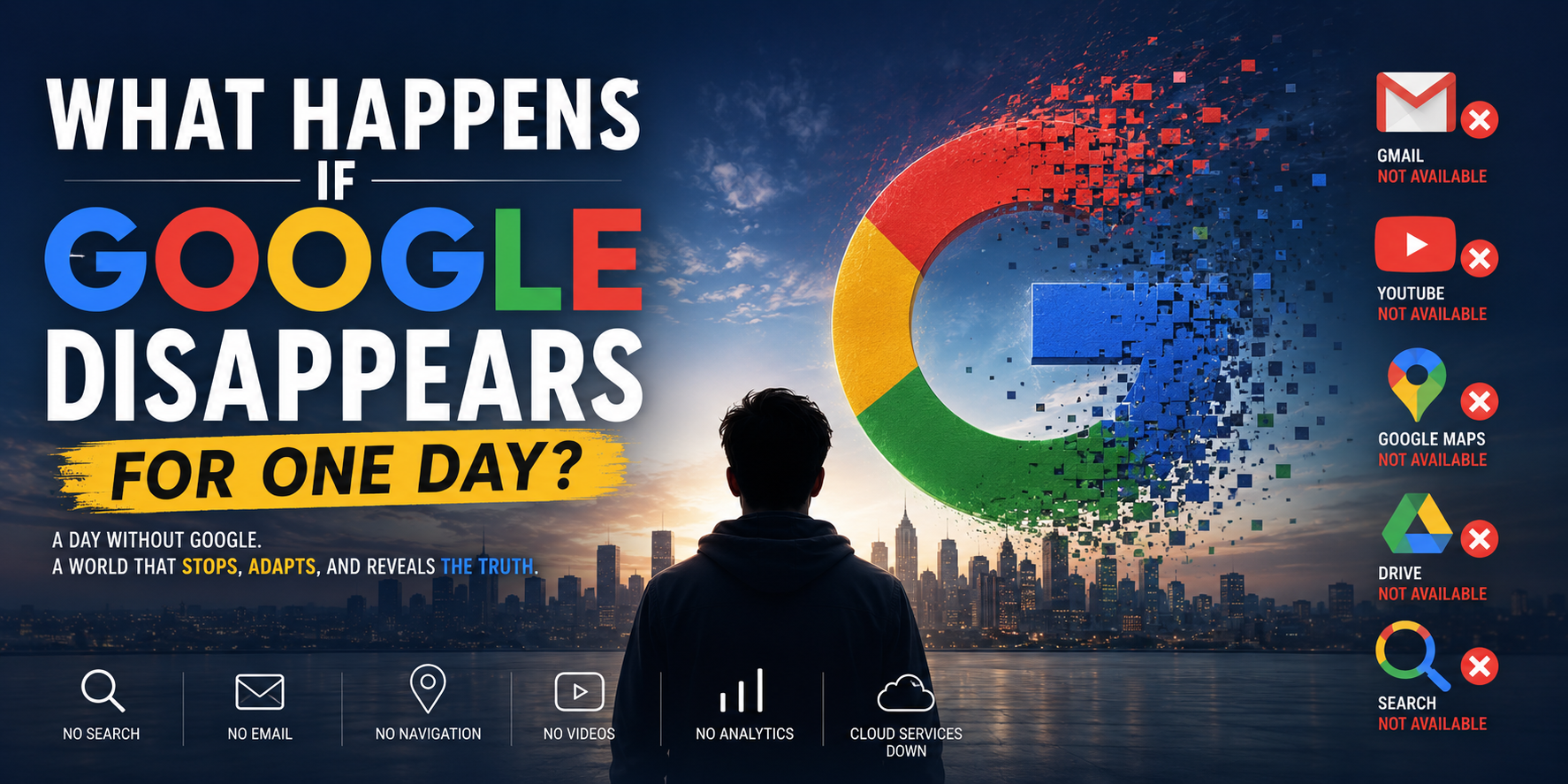
Imagine waking up tomorrow morning, unlocking your phone, and discovering that Google has vanished. No Google Search. No Gmail. No YouTube. No Google Maps. No Android services. For just one day, the company that quietly powers much of the internet goes completely offline.
At first, it might feel like a minor inconvenience. After all, other search engines exist, email services are available, and people survived before Google became a household name. But within hours, the world would begin to realize how deeply Google is woven into modern life.
As both an author and an editor, I find this thought experiment fascinating because it reveals something important: Google is no longer just a search engine. It has become part of the digital infrastructure that supports communication, navigation, business, education, entertainment, and even emergency services.
The First Hour: Confusion
The earliest signs would appear in the simplest places.
- People trying to search for information would receive errors.
- Students looking up homework answers would be stuck.
- Office workers attempting to access Gmail would find their inboxes unavailable.
- YouTube viewers would discover that videos no longer load.
Social media platforms would immediately fill with questions: “Is Google down?” “Can anyone access Gmail?” “Why is YouTube not working?”
Ironically, many people would try to search Google to find out why Google is not working.
The First Few Hours: Businesses Feel the Shock
For millions of businesses, the impact would be immediate and measurable.
Advertising Stops
Companies that rely on Google Ads would suddenly lose one of their primary customer acquisition channels.
Email Workflows Break
Organizations using Google Workspace would struggle to communicate internally.
Delivery Operations Slow Down
Drivers depending on Google Maps would need alternative navigation tools.
Analytics Go Dark
Websites using Google Analytics would temporarily lose visibility into traffic and customer behavior.
Large corporations often have backup systems, but small businesses would be hit hardest. A local restaurant that depends on Google Maps listings and Google reviews might suddenly become difficult for customers to find.
Education Takes an Unexpected Hit
Many schools and universities now rely heavily on Google services.
- Google Classroom assignments would become inaccessible.
- Shared Google Docs could not be edited.
- Research conducted through Google Scholar would be interrupted.
- Online learning sessions linked through Google accounts might fail.
Teachers would quickly switch to alternative platforms, but the disruption would expose how dependent educational institutions have become on a single technology ecosystem.
Navigation Becomes a Real Problem
One of the most underestimated consequences would be the loss of Google Maps.
Consider how many people no longer memorize routes. Commuters, delivery drivers, tourists, ride-share operators, and emergency responders often rely on real-time navigation.
Without Google Maps:
- Traffic information becomes less accurate.
- Alternative routes are harder to identify.
- Businesses become harder to locate.
- Travel times increase.
Other mapping services would absorb some demand, but they could become overloaded by millions of unexpected users.
The Internet Traffic Shift
From an editor’s perspective, this is where the story becomes especially interesting.
Google handles an enormous share of global web traffic. If it disappeared for a day, users would scatter across:
- Bing
- DuckDuckGo
- Yahoo
- Yandex
- Brave Search
These platforms would likely experience record-breaking traffic. Some might slow down under the sudden load. For one day, the search engine market would become the most competitive it has been in years.
Content Creators Face Silence
For creators who depend on YouTube, the outage would feel like a blackout.
For YouTubers
One-day impact
No new uploads
Publishing stops completely.
No ad revenue
Monetized views drop to zero.
No livestreams
Scheduled broadcasts fail.
No audience engagement
Comments and community activity pause.
Some creators would migrate temporarily to platforms like Vimeo, TikTok, or Twitch, but a single day of lost visibility could mean significant revenue losses for full-time content producers.
Financial Markets Notice
Investors would react quickly.
Google’s parent company, Alphabet Inc., is one of the world’s largest corporations. Even a temporary disappearance would raise questions about cybersecurity, infrastructure resilience, and cloud reliability.
Companies that depend on Google Cloud services would issue statements, and financial analysts would spend the day estimating economic impact.
Would Society Collapse?
Probably not.
That is the most important editorial conclusion. A one-day Google outage would be disruptive, expensive, and frustrating, but it would not end the internet.
People would adapt surprisingly fast:
- Alternative search engines would gain users.
- Businesses would switch to backup communication tools.
- Drivers would use other navigation apps.
- Students would rely on textbooks and offline materials.
- Friends would message each other through non-Google platforms.
The internet was designed with redundancy, and that redundancy would become visible.
The Bigger Question: What Have We Centralized?
The real lesson is not that Google is indispensable. The real lesson is that modern society has concentrated an extraordinary amount of digital activity into a handful of platforms.
When one company provides:
- search,
- email,
- video hosting,
- cloud infrastructure,
- mobile operating system services,
- maps,
- advertising networks,
- analytics tools,
then a temporary outage becomes a global event rather than a technical issue.
As an author, I see this as a story about convenience. We choose platforms that make life easier.
As an editor, I see it as a story about concentration of power and infrastructure. The more services we place inside a single ecosystem, the more visible that ecosystem becomes when it disappears.
The Day After
When Google returned the next day, millions of people would rush back to their familiar tools. Gmail inboxes would flood with delayed messages. YouTube views would surge. Search traffic would rebound almost instantly.
But something subtle would have changed.
For twenty-four hours, the world would have received a reminder that the internet is not synonymous with Google. Other tools exist. Other networks function. And despite our dependence on a few giant platforms, human beings remain remarkably adaptable.
In the end, the most surprising result of Google disappearing for one day would not be chaos. It would be the realization that while Google powers a huge portion of our digital lives, the internet itself is far larger than any single company.
That realization might be worth more than the day of inconvenience.